
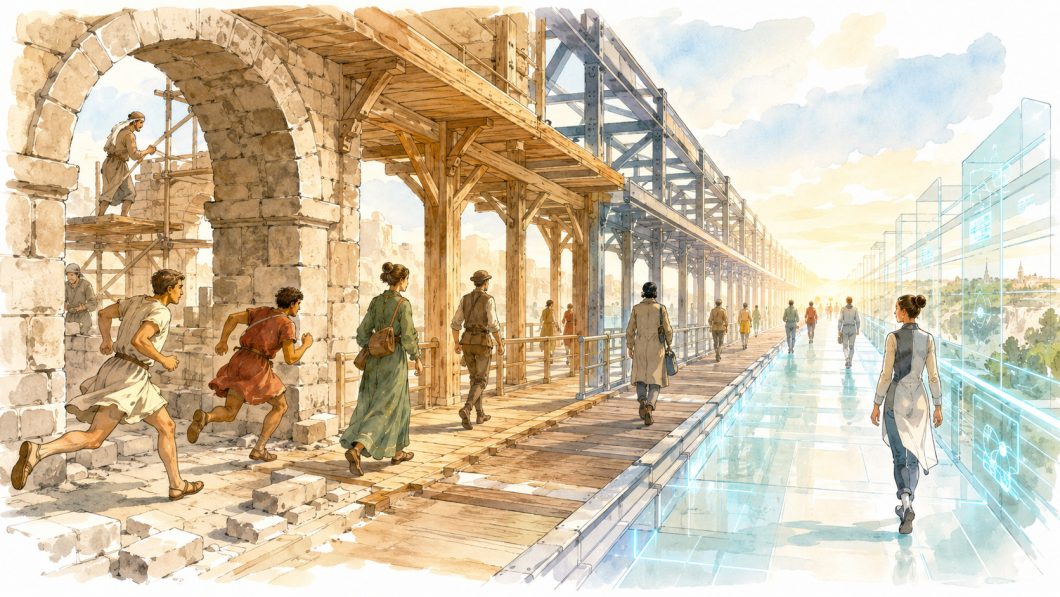
Most of the pressures you work under are built for the short term. Deadlines, quarterly numbers, immediate accountability — the architecture of most organisations rewards the decision that looks good now over the decision that holds up in five years. This is not a character flaw. It is a structural feature, and it systematically produces a particular kind of damage: decisions that win the present and spend the future.
This pillar is about what it takes to think and act past that pressure. Not to ignore short-term obligations, but to hold a longer frame alongside them — to build in a way that holds up, to play as if the game continues after you leave the field. That is harder than it sounds, because the pressures are real and the long horizon is abstract. The sources that inform this pillar are the ones that make the long horizon concrete.
The trap that starts it
Before you can play the long game, you have to recognise when you are not. The characteristic failure is applying a finite mindset to an endless contest — treating a career, a team, or an institution as a game you can win, and making the decisions that look like winning while slowly spending the things that made you worth anything.
→ The Finite Mindset Trap — the Carse/Sinek frame on why finite thinking in an infinite game erodes the very thing it was trying to protect.
The practical mechanism
Recognising the trap is the beginning. The practical question is what you replace it with. The most durable answer is systems. Goals announce a destination; a good system generates the conditions that make the destination reachable — and keeps working when the specific goal changes. The same logic applies to identity: behaviour that flows from who you are sustains itself under pressure in a way that behaviour aimed at an outcome does not.
→ Systems over goals and the identity stack (in development) — the practical mechanism: how small, consistent systems compound over time, and why identity-based habits outrun goal-based ones.
The strategic dimension
Long-game thinking has a strategic dimension that is distinct from the practical one. It includes the willingness to change how you pursue a purpose without changing the purpose itself — what Sinek (following Carse) calls existential flexibility. It includes the ability to hold a purpose that is larger than any one delivery — stewardship as the long-horizon virtue. And it includes the discipline of patience: not passivity, but the willingness to hold a position while conditions develop, rather than forcing a resolution the situation isn’t ready for.
→ Stewardship past your lifetime (in development) · Existential flexibility (in development) — the strategic-patience and stewardship seams, drawn from sources including Lord of the Rings and Dune.
The thread across all of it
A short-term mindset isn’t stupid. In most contexts it is rational: the incentives are immediate, the accountability is immediate, and the damage is diffuse and delayed. What the sources in this pillar share is the recognition that you can be locally rational and systemically corrosive — and that the people and organisations that last tend to be the ones who found a way to hold the longer frame even when the pressures were pushing in the other direction.
That is what the long game requires: not a different set of decisions in some abstract future, but a different frame applied to the decisions you are making right now.
Where to start
The finite mindset trap is the entry point — it names what you are trying to avoid. Systems over goals is the practical follow-on — it names the alternative mechanism. The strategic seam (stewardship, existential flexibility, the just cause) is in development and will be linked here as it publishes.
This pillar draws on five sources on long-horizon thinking: The Infinite Game (Sinek, 2019 — applying Carse’s 1986 framework, anecdote-based lens); Atomic Habits (Clear, 2018 — popular synthesis, figures illustrative not empirical); Lord of the Rings (Tolkien — fiction, used as analogy); Dune (Herbert — fiction, used as analogy); and a fifth source currently on hold pending editorial review. See How We Use Sources for how sources are classified and used.