
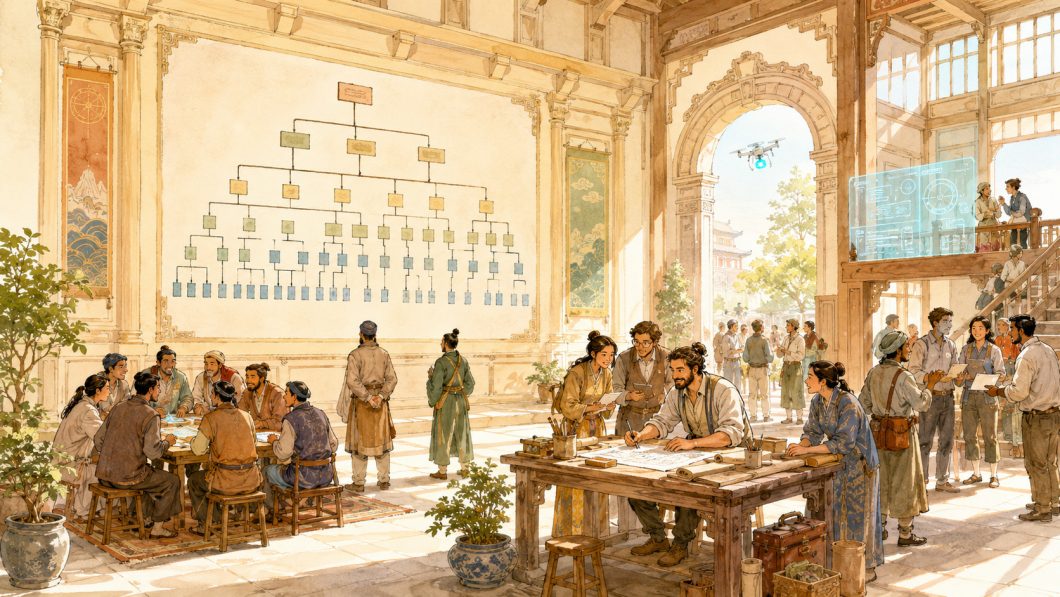
There is the authority an organisation chart describes, and there is the authority that actually operates. They overlap, but never completely, and the space between them is where a surprising amount of institutional life happens — including most of its failures.
This pillar is about that space. Who actually has the power to decide. Whether that power is legitimate or merely held. What happens when the people with authority don’t understand the situation, and the people who understand it can’t act. And what it costs — to a person and to an institution — when someone challenges an authority they believe is wrong.
The sources that inform it range widely: a nuclear submarine during an ambiguous crisis, an investment bank on the night it discovers it is insolvent, a Cold War prisoner exchange, a desert empire built on a scarce resource, and a medieval kingdom defended by a man who chooses to surrender it. Different worlds, one question: where does power actually sit, and what follows from the answer?
For how we use sources like these, see How We Use Sources.
The gap between authority and understanding
The most consequential pattern in this pillar is the separation of authority from understanding. In most hierarchies, the people who understand a situation most fully are not the people with the power to act on it — and the people with the power don’t have the understanding. Information has to travel up to where the authority sits, losing texture and meaning on the way.
→ The Comprehension Gap develops the failure mode — the structural separation, why it persists, and why it is no one’s fault and everyone’s responsibility.
→ Move Authority to the Information develops the structural cure — pushing authority down to where the understanding already lives, and the two preconditions (competence and clarity) without which that fails.
These two pieces are a matched pair: the disease and the cure. Read together, they make the strongest single argument in this pillar.
What makes authority legitimate
Authority that is merely held is fragile. Authority that is recognised as legitimate is durable. The difference is not always visible from the outside — both look like power — but it determines what happens under pressure.
The sources approach legitimacy from several angles. A leadership framework argues that authority and total ownership of outcomes are inseparable — you cannot claim the first without accepting the second.
→ Decentralised command: the canonical pair (in development) — develops the relationship between distributed authority and owned accountability, drawing on two military-leadership accounts that approach it from opposite directions.
A historical drama poses the question more starkly: what makes a leader’s command worth following when following it has a real cost? This material — drawn from Kingdom of Heaven, a source treated with particular care given its subject — sits at the boundary between this pillar and the question of conscience.
→ Conscience over orders (in development — human review required before publication) — develops the point at which legitimate authority and individual conscience come into conflict.
The cost of the challenge
A healthy authority structure includes a mechanism for lawful challenge — a way to question a decision before the only options left are compliance or mutiny. Without it, the people who can see a problem have no sanctioned way to raise it, and the structure depends entirely on the people at the top being right.
→ Designed-in dissent / the two-person rule (in development) — develops this, drawing on a military-command scenario where being wrong in either direction is catastrophic and the structure itself has to carry the disagreement.
The deeper point is that dissent is not a threat to a well-designed authority structure — it is a feature of one. A structure that cannot be lawfully challenged is not strong; it is brittle, and it will discover this at the worst possible moment.
The through-line
What unifies these sources is that they all refuse the simple picture in which power sits where the chart says it does and works the way the chart implies. Real authority is distributed unevenly against understanding, varies in legitimacy, and depends — more than most structures admit — on whether it can be questioned.
The practical implication runs through every spoke in this pillar: if you want to know where power actually sits in an organisation, do not read the org chart. Look at who understands what is happening, who can act on it, whether those are the same people, and what happens to the person who says “I think this is wrong.”
This pillar draws on seven sources: Crimson Tide, Margin Call, Bridge of Spies, Dune, Kingdom of Heaven (used as analogy and historical dramatisation), and the non-fiction Turn the Ship Around! (Marquet) and Extreme Ownership (Willink & Babin). Kingdom of Heaven is treated as a HIGH-sensitivity source; content drawing on it carries a human-review requirement and keeps history and dramatisation distinct. Margin Call is used as analogy only and is not financial advice. See How We Use Sources.