
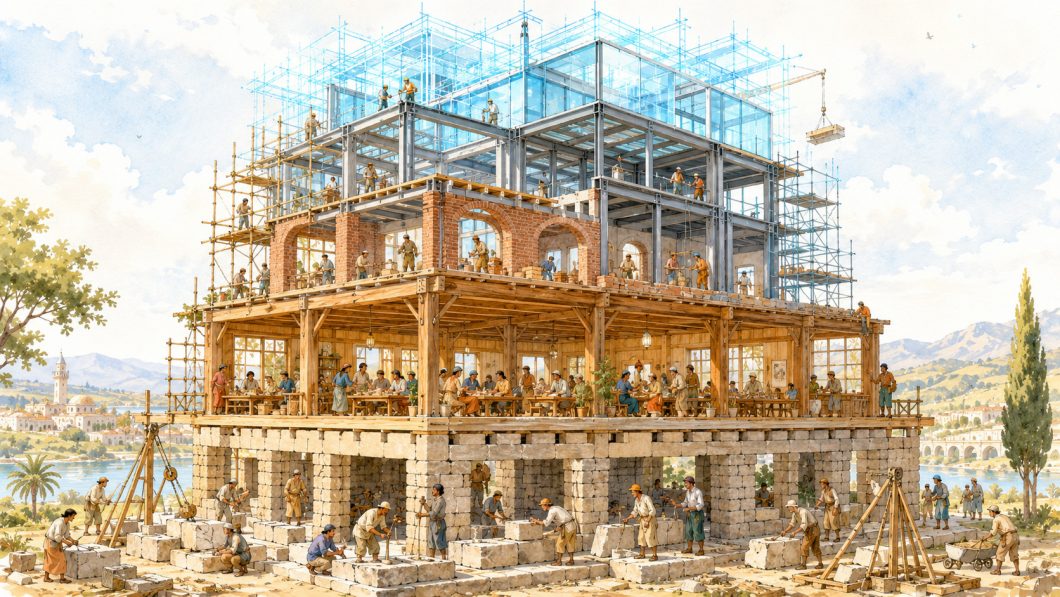
Most explanations of why a team isn’t working point at the visible problems. People aren’t aligned. They’re not motivated. They’re not delivering. The instinct is to address the thing you can see — to push harder on results, demand more accountability, run another alignment session.
This almost never works, and the reason it doesn’t is the most useful single idea in this pillar: the problems you can see are usually symptoms of problems further down. A team struggling with results is rarely struggling with results. It is usually struggling with something two or three levels beneath them — and until that’s addressed, the visible problem keeps coming back, however hard you push on it.
This pillar is a map of what actually makes a team work, built from the sources that have looked at the question most carefully — a submarine captain who gave his authority away, a crisis team 200,000 miles from home, a researcher on how people handle failure, and several others. The pieces below develop each part. This page is the orientation. For how we use sources like these, see How We Use Sources.
Start at the foundation
The base of a working team is a particular kind of trust — and it is not the kind most teams mean when they use the word.
The trust most teams have is reliability trust: confidence that colleagues will deliver. That matters, but it is not the foundation. The foundation is the willingness to be seen as imperfect — to say “I was wrong,” “I need help,” “I don’t know,” in front of people whose opinion affects your standing. Without that, people protect themselves rather than the work, and everything built on top is compromised.
→ Vulnerability-Based Trust: The Foundation Every Team Skips — what the foundational trust actually is, and why it has to come from the top first.
This is where the work starts, because nothing above it holds without it.
Build the conditions in order
Once the foundation is in place, the conditions stack in a specific order, each resting on the one beneath.
Honest conflict. A team that can be vulnerable can disagree productively — argue about ideas openly rather than nodding in the meeting and relitigating in the corridor. The absence of conflict is the danger sign, not its presence; a meeting where everyone agrees is usually one where the truth went unspoken.
→ Productive conflict vs artificial harmony
Distributed authority. A working team puts decision-making where the understanding is, rather than concentrating it at the top and waiting for information to climb up to it. This is as much a structural choice as a cultural one — and it has preconditions.
→ Move Authority to the Information and Decentralised command: the canonical pair (in development) — giving control from the bottom up, and owning the outcome from the top down. A working team needs both.
Learning from failure. A team improves only if failure is treated as information rather than a verdict. This governs whether people surface their mistakes or bury them — and a team that buries them cannot learn from its own experience.
→ Fixed vs growth mindset (in development) and Work the problem: calm as the first product (in development)
Iteration over prediction. Working teams deliver in short cycles, inspect honestly, and adjust — rather than planning exhaustively up front and executing blindly. The discipline is empirical: the plan is a hypothesis revised against evidence, not a contract to defend.
→ Iterate, inspect, adapt (in development)
The thread that runs through all of it
Across all nine sources that inform this pillar, one observation recurs from different directions: the leader’s primary job is not to be the best performer or the decisive decision-maker. It is to build the conditions in which the team can do those things without them.
The submarine captain’s test of whether he had genuinely distributed authority was whether the ship still worked — and kept producing leaders — after he left. The crisis team’s first product was not a solution but the calm that made solutions findable. The teams that handle failure well are led by people who can be seen to fail. In each case, the leadership is structural and largely invisible: it shows up in what the team is capable of, not in what the leader personally does.
This is the through-line of the pillar. A team that works is usually a team whose leader spent their effort on the conditions rather than the outputs — and the outputs followed.
Where to start
If you are reading this because something on your team isn’t working, the map suggests a specific move: don’t start with the visible problem. Start one or two levels beneath it. A results problem is often a conflict problem; a conflict problem is often a trust problem; a trust problem usually starts with whether it is safe to be seen as imperfect — which usually starts with the person leading.
The pieces below take each of these in turn. The foundation piece is the place to begin.
This pillar draws on nine sources, each used as a framework attributed to its author and carried with its own limitations: The Five Dysfunctions of a Team (Lencioni), Turn the Ship Around! (Marquet), Extreme Ownership (Willink & Babin), Mindset (Dweck), Scrum (Sutherland), Emotional Intelligence (Goleman), How to Win Friends and Influence People (Carnegie), and the dramatisations Apollo 13 and Kung Fu Panda. See How We Use Sources for how each kind of source is used. Several carry specific caveats — the fable structure of the Five Dysfunctions model, the contested replication record of mindset interventions, the retracted EQ-over-IQ claim, the marketing nature of the “twice the work” promise — and these are noted in the relevant spoke pieces.