
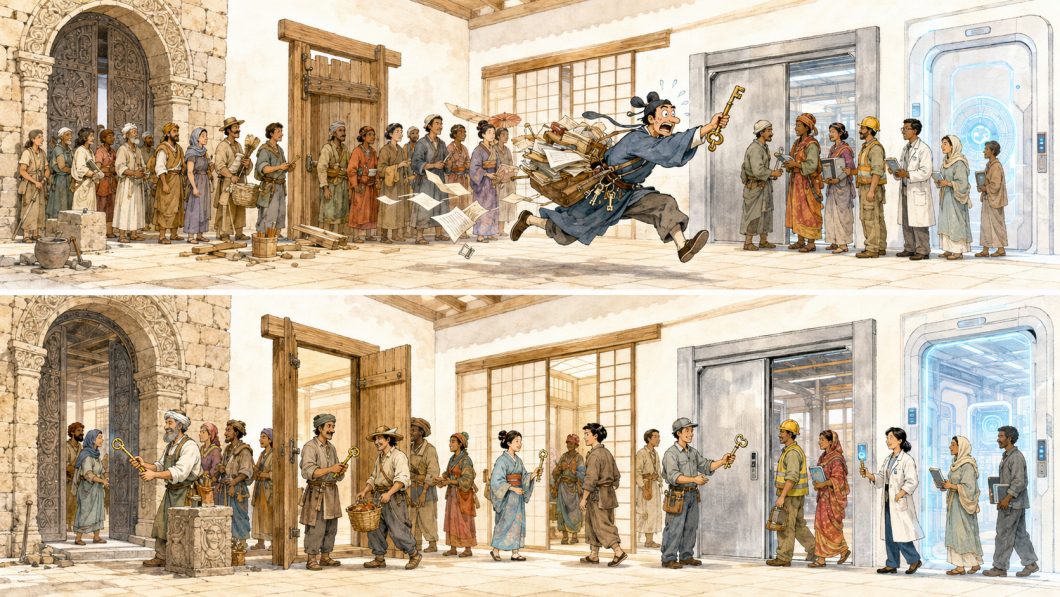
There is a standard model for how authority and information are supposed to interact in an organisation. The people at the top have the authority to make decisions. The people at the bottom have the information. So the information travels up — through briefings, reports, summaries, slides — to the place where the decisions get made.
The problem is what happens to information in transit.
It gets summarised. It gets smoothed. It loses the texture that made it meaningful. The person who actually knows what is happening has to compress what they know into a format the decision-maker will absorb, and in that compression, the thing that most needed to be conveyed is often the thing most likely to disappear. By the time the information reaches the authority, it is cleaner, simpler, and less true than when it started.
This is not a failure of communication. It is a structural property of any system in which the people with authority are separated from the people with information. The compression is not optional; it is what the system requires.
L. David Marquet, a retired US Navy submarine captain, spent his command on the USS Santa Fe working on the structural alternative.
The inversion
The default flow is information up, authority down. Marquet’s intervention is to invert it: move the authority down to where the information already is.
The principle — which he calls leader-leader, as opposed to leader-follower — is that the leader’s job is not to make decisions but to build an organisation full of decision-makers. Every person in the chain should have the authority to act on what they understand, not wait for permission from someone who understands it less.
The shift sounds straightforward. In practice, it requires two things to be true before it can work safely, and most attempts at it skip both of them.
The two preconditions
The first precondition is competence. People need to be genuinely capable of making the decisions they are being empowered to make. Distributing authority to people who don’t yet have the technical knowledge or judgment to use it well isn’t delegation — it’s abdication. The precondition is specific: give control only as fast as the competence to exercise it can be built.
The second precondition is clarity. People need to understand what the organisation is trying to achieve — not just their own task, but the purpose behind it, well enough to make decisions that cohere with each other without being individually supervised. Without shared clarity, distributed authority produces distributed confusion: everyone deciding autonomously in different directions.
Empowerment without competence is recklessness. Empowerment without clarity is chaos. Most attempts to “give people more autonomy” fail on one or both of these, and the failure gets attributed to the people rather than the structure.
What it looks like in practice
Marquet describes a specific mechanism: replacing “request permission” language with “state intention” language. Instead of “request permission to dive to sixty metres,” a crew member says “I intend to dive to sixty metres.” The content is the same. The cognitive position is different. The first formulation puts the thinking with the person who grants or refuses permission. The second puts the thinking with the person who will execute — they have to know what they intend and why, not just wait for a yes.
Three words — “I intend to” — quietly shift the ownership of a decision. The person speaking has to have thought the action through. The person listening has the chance to intervene if something is wrong, but defaults to trust rather than checking.
The details of Marquet’s account are from a specific context — a nuclear submarine during 1999–2001, with a specific crew at a specific operational moment. He is careful about this, and the limit it implies is real: one ship, one captain, strong results, but not a controlled study demonstrating universal transfer across organisational types. Use the mechanisms for what they are — a precise description of one rigorous attempt — and apply them to a different context thoughtfully, not as a formula.
The structural cure
There is a specific failure mode that this approach addresses directly. It is the failure mode in which the people who understand a situation cannot act on it, and the people who can act on it do not understand it. The gap between those two things is structural — it is built into any system where authority sits above the information rather than alongside it.
Pushing authority down closes the gap from the authority side. The people who understand the situation are given the power to act on it. The decisions improve because they are made by the people with the most relevant information, not by the people with the most seniority.
The gap can also be closed from the other side — pulling understanding up. This is what most organisations try. It is slower, lossier, and it requires the people at the top to absorb an amount of technical detail that, past a certain scale, is simply not possible. Moving authority to the information is the structural solution; moving information to the authority is the workaround.
The leader’s job, redefined
There is a practical implication for what it means to lead well under this model. The leader who has distributed authority is no longer the person whose decisions make the organisation work. They are the person whose team-building, teaching, and clarity-creating makes the organisation capable of working without them in the decision loop.
Marquet’s account includes a detail that illustrates this. After he left the USS Santa Fe, the culture continued — and the ship continued to produce a disproportionate number of officers and commanding officers. The change he made was not in the decisions he took but in the decision-making capacity he built. The test of whether authority has genuinely been distributed is not whether the organisation functions while the leader is present. It’s whether it functions, and whether the quality holds, when the leader is gone.
L. David Marquet’s account is drawn from Turn the Ship Around! (2012, Portfolio/Penguin). It is a first-hand practitioner account from a single command, not a controlled study. The mechanisms — leader-leader, “I intend to,” moving authority to the information — are used here as a framework attributed to Marquet.